
The German Pharmacy Museum: Time Travel for All the Senses
Housed in the glorious ruin that is Heidelberg Castle, the German Pharmacy Museum is a delightful assault on the senses—jars, vials, boxes of herbs, minerals, and powders await the pharmacist’s hands. A stuffed alligator with a toothy grin hangs overhead while a unicorn stares down from the wall. The scents of lavender, menthol, and pine waft about you as you wander through actual antique apothecary shops and a pharmacist’s laboratory.
Let’s go have a deeper look.

The Charm and Utility of the Original Apothecary’s Craft
Nowadays, when you go into a drugstore, it’s likely to be large, white-walled, and illuminated with blinding lighting. There may well be bullet-proof plexiglass between you and the pharmacist or clerk. The main business will be selling pre-measured, pre-packed, and highly advertised medicaments in a sterile, impersonal environment.
Such a utilitarian space is seldom inviting. And certainly never charming or entertaining. But this was not always the case.
Back in the day, the pharmacist, or apothecary, was something of a wizard, a cross between the mundane and the magical. He worked surrounded by glass vials and majolica jars identified by labels with exotic names written in Latin script. From drawers full of herbs and roots, boxes of crushed bones and minerals, bottles of essential oils and powdered animal parts, he would concoct his magical formulas to treat whatever ailed you. Mortars and pestles, weighing scales, and long-nose glass distilling jars surrounded him as the everyday tools of his trade.
At the German Apothecary Museum, in Heidelberg, we get to see this history for ourselves, in person, not just in old prints. Here, we get to see the world’s largest collection of high-quality, well-curated items—over 20,000 individual pieces—covering 2000 years of history of the druggist’s trade. It is one of the most popular museums in Germany, with some 700,000 visitors a year.
Where You’ll Find the German Apothecary Museum
The good news about this unique museum is that it’s hard to miss for any visitor to Heidelberg, Germany. You wouldn’t think of coming to this beautiful German city on the Neckar River without making a stop at its romantically ruined castle on the hill (or at least I hope you wouldn’t). When I first visited Heidelberg Castle, I had never even heard of the Apothecary Museum and had no idea it was here. But that’s where you’ll find this intriguing spot very much worth a visit.
It’s located in the crypt-like basement rooms of the Ottheinrich Building, the half-ruined, windowless Renaissance façade to your right as you enter into the castle’s cobbled courtyard. Indeed, part of the museum is located in the Apothecary Tower, where the actual court chemist was housed when the castle was inhabited.
Admission is included in the price you’ve already paid to enter the castle grounds, so there’s no excuse not to give it a look.

A Short (I Promise) History of the Apothecary Trade in Europe
We humans as a species have always had times when we have fallen ill. The first evidence of written prescriptions is on Sumerian tablets covered with cuneiform writing that date back as far as the 4th millennium B.C.
Throughout our early history, illness was connected with the gods, so it made sense to apply to them to heal us. From the Greek and Roman god Asclepius, with his snake-entwined staff, to medieval Magi, with their healing balms, to Christ envisioned as a healer/pharmacist, elements of mythology, religion, and the healing arts have always been intertwined.

Up until the 13th century, apothecaries in Europe were often on a level with wizards, alchemists, or priests. They often served as physician and pharmacist both, diagnosing, prescribing, and compounding their tinctures, oils, salts, and salves.
1231 – The Law that Changed Everything
That situation changed in 1231, when the Holy Roman Emperor, Frederic II issued the Constitutions of Melfi, or Liber Augustalis.

This was a new system of legislation designed to unify and codify the laws in the Kingdom of Sicily, where Frederic had his court. For the first time the professions of physician and pharmacist were made legally separate and distinct.
With these new laws, the apothecary/pharmacist became an esteemed and well-respected medical professional. Or at least the men did.
Although it was quite common for women to serve as local healers, especially in small towns and rural areas, they sometimes ran the risk of being accused of witchcraft, especially if they were good at their craft. Remember Claire Fraser, in Outlander, being nearly burned to death as a witch in 18th-century Scotland?
Knowledge Begins to Bloom
Chemist shops began to spring up all over Europe. In the 18th century, the “doctrine of signatures” came into popularity. This outlined the idea of “like cures like,” which became the basis for homeopathic medicine that is still in use today.
It’s based on the idea that something that causes symptoms of illness in a healthy person can treat one with similar symptoms by triggering the body’s natural defenses. This explains cures seen in the museum like ground human skull bone used to treat migraines.
In fact, it is this very “like cures like” hypothesis that led to the invention of the smallpox vaccine, way back in the 18th century, which used a small dose of cowpox to create an antibody reaction in the vaccinated person.
The museum displays lead us through the history of pharmaceutical healing. We travel from prehistoric cures to the alchemy of the Dark Ages, from the monastic practices of the early Middle Ages, to the Renaissance and up to today.
Seeing the Real German Apothecaries of Yore
The real “meat” of the museum, for me, is the several reconstructions of actual historic pharmacies, or officinas (Latin for workshops). Here the past is brought right into the present for us to see.
Several genuine vintage apothecaries, plus bits and pieces of others, have been moved and reconstructed in the museum’s rooms, and we get to stroll through them for an insider’s look at the early world of medicine and pharmacology.
Transported From a Corner in Ulm

The old Crown Pharmacy, which dates from about 1820, was moved here from the city of Ulm, where it sat on a corner. In cherry-wood cabinetry set against walls painted the same blue as the original pharmacy, each drawer and box is carefully labeled with its contents. On the workbench sit a few tools of the trade, a bell jar, bottles, and always a scale.
Step Up to the Window
The most interesting recreated pharmacy to my mind is the mid-18th-century Court Pharmacy from Bamberg. Gorgeous woodwork, shelves of majolica jars, and interesting levels draw the eye.
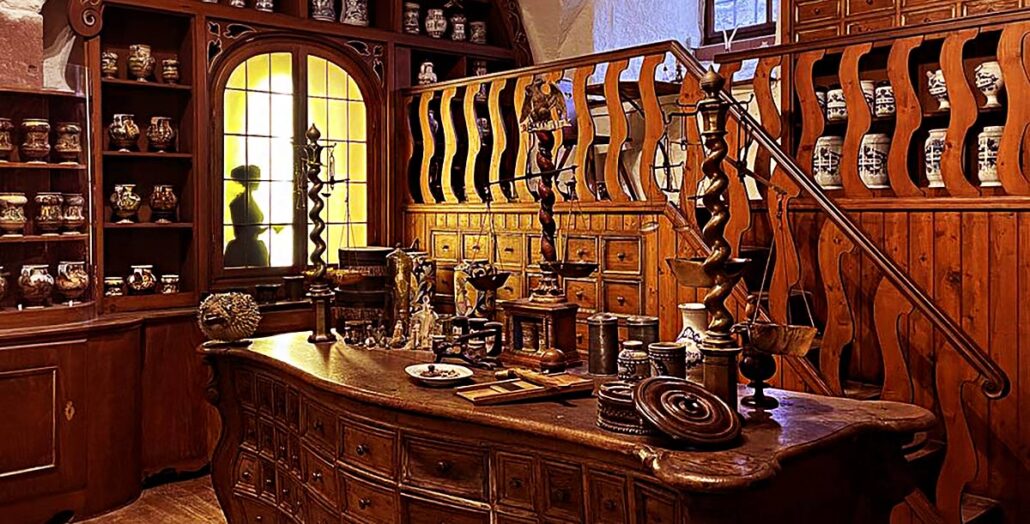
At first, it seems like the beautiful Rococo worktable at the center would be the public counter where the chemist met with customers. However, that would be wrong. In fact, up until about the 18th century, customers didn’t enter the shop at all.
At the left of the work area, we can see a double window that opens to the outside. The customer would come to this window, hand her prescription through to the pharmacist, and then he or one of his apprentices would compound it in the workspace and hand it back through the window.
Sort of an early version of the drugstore drive-thru?
An Alligator Stuff’d
Every part of this officina is gorgeous or fascinating, but my favorite thing is the stuffed alligator or crocodile hanging overhead.

Why an alligator, you might ask?
Well, alligators have for centuries been associated with apothecary shops. In 1597, when the Bard wrote Romeo and Juliet, he described the scene where Romeo goes to the apothecary to obtain a poison to kill himself after he learns of Juliet’s supposed death. Overhead hangs “An alligator stuff’d, and other skins of ill-shaped fishes.” Maybe that also explains the “porcupine fish,” aka a puffer fish, which we can see at the far end of the worktable.
At a time when most of the customers would have been illiterate, the alligator and other strange and magical things like unicorns likely signaled to the customers that the pharmacist had access to every sort of rare and exotic cure—animal, plant, and mineral.
Religious Elegance
Another elegant and complete apothecary on exhibit is the officina of the Ursuline Convent at Klagenfurt, Austria, dating from 1730. Here there is no window to the street, as the only “customers” were the other members of the convent. The faience jars made me want to get a closer look. What a beautiful space to spend one’s working day.
The letters IHS (Iesum Habemus Socium, “Jesus is our Companion”) is evidence of its origin and use in a religious environment.

By far the most purely beautiful reconstructed apotheke is the Officina from the Benedictine monastery at Schawarzach, dating from the first half of the 18th century.
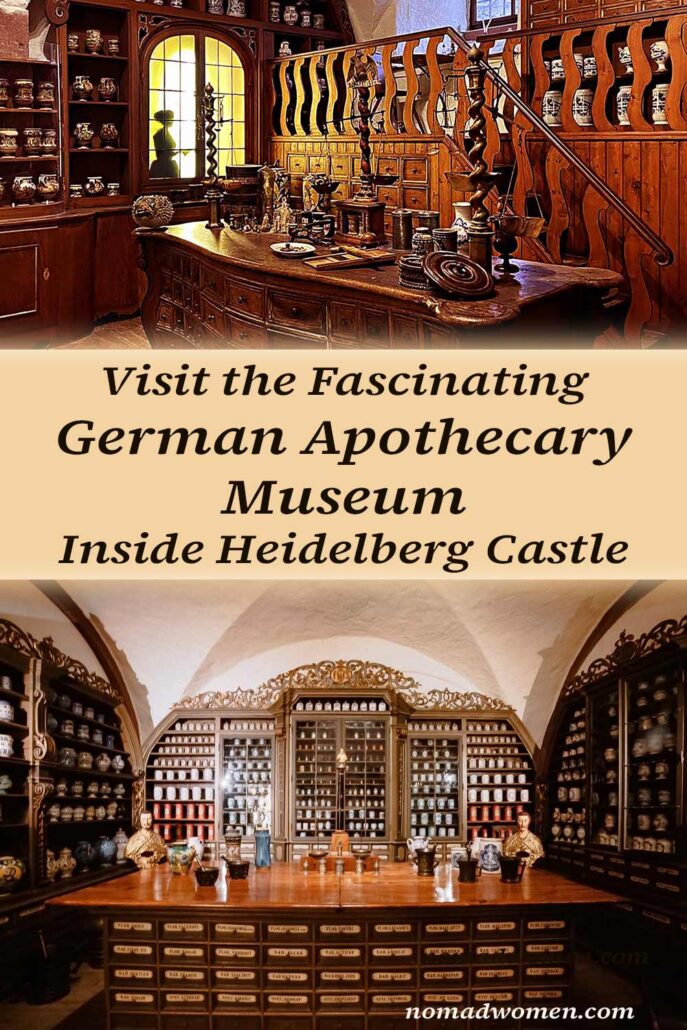
You can see it in the photo at the top of the page.
At either end of the worktable stand statues of Asclepius, the Greco-Roman god of medicine holding his snake-coiled staff, and his daughter Hygieia, the Greek goddess of health. The worktable is beautifully painted and labeled.
What a joy to have such a beautiful place to do one’s work.
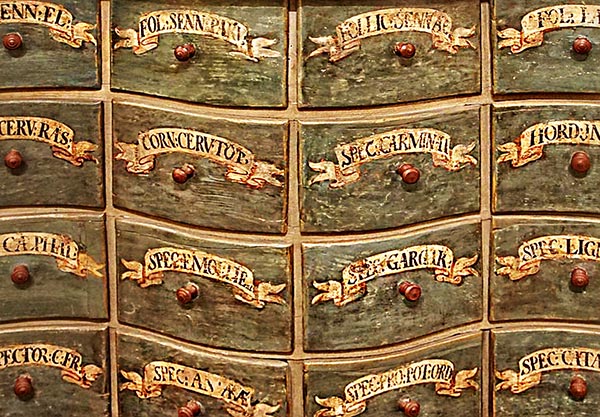
All of the recreated apothecaries fit beautifully into the arched and vaulted spaces of the castle cellars, taking advantage of the curved lines to show them to best advantage.
From Mandrake to Ambergris, Bezoar Stone to Powdered Mummy
In the section showing the history of medicaments, there are 28 wood and glass showcases full of everything you’d expect and a lot you wouldn’t. Bezoar stone, for instance—a hardened mass of chewed hair formed in the stomach of a ruminant animal, like a cow, sheep, or goat—was often used as an antidote for poison. Ambergris—aka whale vomit—had a strong scent useful against fainting. We learn that in the 16th century, pulverized mummy was considered a remedy for cough, sore throat, shivers, or a broken heart.
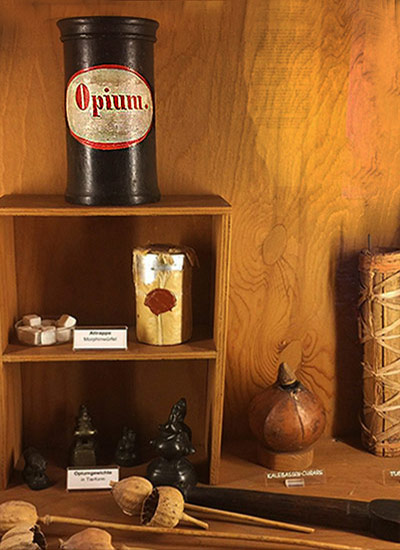

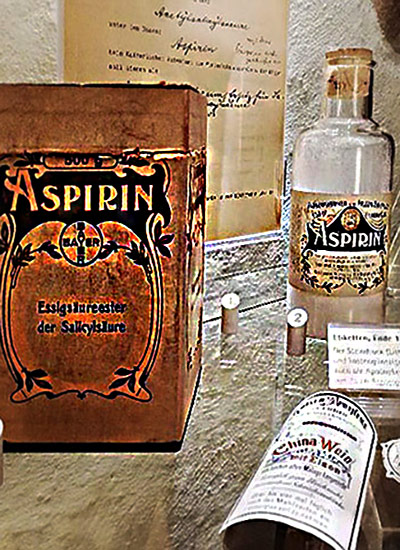
The exhibits in this section come right up into the 20th century, showing the development of more familiar cures like the discovery of penicillin and quinine, insulin, and the development of aspirin.
The Art of the Cure
Art is not neglected in this 20,000-piece collection either. There are many paintings and other works of art showing the art of pharmacy through the ages.
These include shop signs and emblems to identify the apothecary for a largely illiterate public.
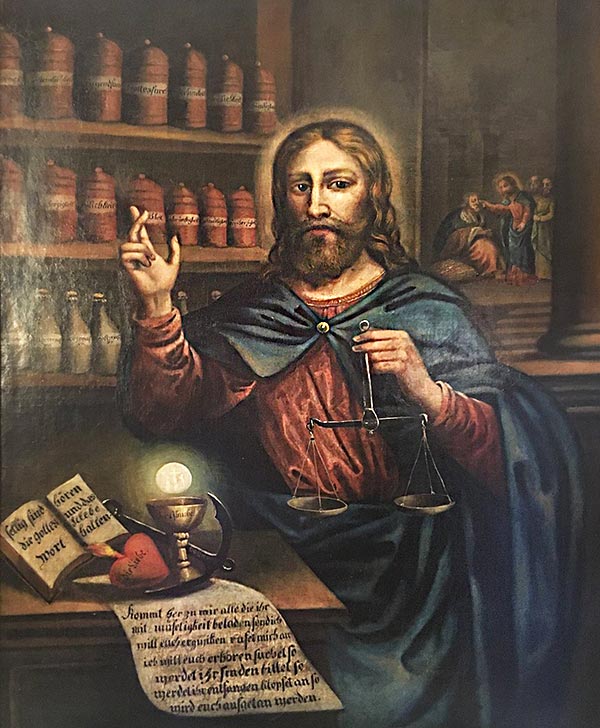
One of my favorite artworks in the collection is a painting showing Christ as a heavenly pharmacist, weighing souls on the apothecary’s scale.
The cardinal virtues of faith, hope, and love are symbolized by the chalice, anchor, and heart on the chemist’s workbench.
More Magical Beings
And about that unicorn… Medieval people absolutely believed unicorns were real and what do you know? Here is one right up on the very wall. The size of its head is a bit small, but its horn is enormous.
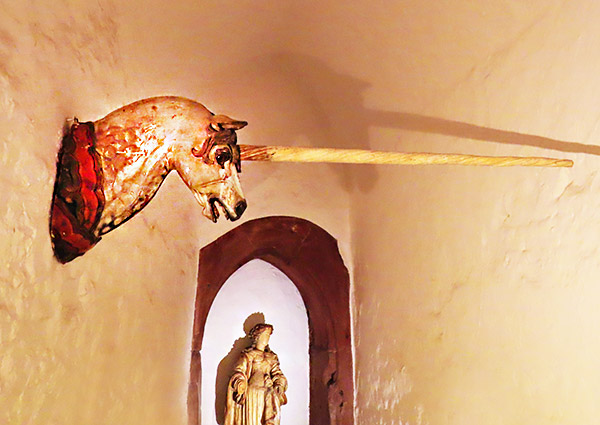
Well, okay, so it’s not really a unicorn, though many over the centuries must have imagined it was. The head is a carving, but the 2.2 meter (seven feet) long horn is “real.” It’s not a horn though. It’s actually a tooth, the tusk of a narwhal.
When ground unicorn horn was called for in a healing compound, this is what they used. Or sometimes they used powdered mammoth teeth.
The Kids are Not Forgotten Here
One favorite spot for all visitors to the museum is the Kinderapotheke or Children’s Pharmacy. And although they say it’s for kids, adults love it too. Here you can handle and smell various herbs, bark, spices, and other items to try and guess what the scent is from. You can also gather spices and aromatics to make your own tea.
The Apothecary Tower
The final exhibit room in the museum is the laboratory, located in the beautiful round Apothecary Tower, built in the 15th century as part of the castle’s original fortifications. It is designed to give an overview of how medicines were created by the apothecary.

Whether ground and powdered, dried, roasted, boiled, distilled, the ingredients needed to be treated and turned into a substance that a patient could easily consume. We see a wide range of instruments, distilling equipment, presses, mortars, bottles and jars, vessels, flasks, and vials. There are crucibles and burners, knives and strainers, horn spoons and an athanor, a kind of slow combustion stove often seen in dispensaries in the 18th century.
Finally, Take an Apothecary Memento Home With You
When you’ve seen all the museum has to offer, it will finally lead you into a small but charming gift shop. Here you can buy replicas of some of the beautiful majolica and enameled jars.
There are lovely hand-made soaps, dried sage smudge sticks, essential oils, books, and even some candies. Try a package of the “Magenmorsellen,” a sweet compounded from cinnamon, ginger, cloves, and other spices to a pharmacist’s recipe hundreds of years old.
The German Apothecary Museum does not disappoint. I found it to be a wonderful and fully fascinating surprise. In fact, I could have spent much more time than I had. Do give it a visit. I promise it’s worth it
Fast Facts and Practicalities
Opening Hours
The German Apothecary Museum is open daily year-round, except for Christmas day. In low-season (Nov 1-March 17) the hours are 10am-5:30pm. In high season, (March 18-Oct. 31), hours are 10am-6pm. Plan on at least 30 minutes for the museum, though I really think one hour is the minimum needed to see everything. More if you like reading every placard and label
TIP: I suggest coming right when they open to avoid having to wait in line. Come directly at 10:00 then plan to visit the rest of the castle after you finish.
Language
And speaking of reading every label, I should note that although the major markers and explanations in the museum are in both German and English, many of the smaller signs are not. I strongly recommend getting one of the audio guides on your way in. It’s worth it to not miss out on a lot of interesting information.
Accessibility
Unfortunately, as the museum is situated in the cellars of the castle, much of it is not very accessible for those with mobility problems. It is not wheelchair accessible at all. There are three steps down into the museum from the castle courtyard. Six of the ten rooms inside are then at ground level or have small ramps that are not too difficult to negotiate. However, the other four rooms can only be accessed by steep, narrow stairs. Staff at the information desk will be happy to give you an explanatory sheet and photos so you can get some sense of what is there.
How to Get to Heidelberg Castle and the Museum
The easiest way to get to the castle is on the Bergbahn funicular. You can find the modern station with a ticket window in the Kornmarkt, in the Old Town. Your round-trip ticket to the first station includes entrance to the castle and the museum. The funicular runs every ten minutes.
If you prefer not to ride the mountain railway, you can walk up, up, up a steepish path or climb the 330 steps from Kornmarkt to the castle gate (and they are numbered so you know how far you still have to go!)
There is so much to see and fall in love with in Heidelberg, Germany. Check out these other Heidelberg posts as well.
The Heidelberg Funicular to the Castle: Riding with My Grandfather
Boys Behaving Badly: The Student Jail at Heidelberg University
Stolpersteine: Stumbling Across Reminders of the Holocaust
A Visit to the Heiligenberg, Heidelberg, Germany’s Holy Mountain
Visiting the Thingstätte, Heidelberg: an Older Woman’s Quest for Understanding
Pin it For Later


Fascinating and wonderful as always.
So much is learned just in the reading of this piece. I have only been to Heidelberg once almost fifty years ago. Missed this jewel if it was there at that time. Can’t wait to see it.
Many thanks.
Keep traveling and keep writing.
Thanks Janet. I’m glad you enjoyed it. I loved it but realized there were holes in my knowledge still while writing the post. I really enjoyed researching more so now I want to go back,