
Heidelberg Castle, Germany—the Definition of Romanticism (2024)
Romantic, lovely Heidelberg, Germany, would be just another lovely, romantic German town but for the majesty of its icon, Heidelberg Castle. Also known as Heidelberg Palace, because it truly is a palace within a castle within a fortress, Schloss Heidelberg (its German name) has drawn visitors to this pretty city on the Neckar River for centuries.

The sunset-colored pile of stones set against leaf-tangled green—in shades from jade to emerald to malachite—is a beacon and a guardian, watching over the town spread out at its feet. Its haphazard silhouette is visible from all over town and is part of the very soul of Heidelberg.
With more than a million visitors every year, the castle is one of the most important tourist attractions in Germany.
As I rode the Bergbahn Funicular up the mountain for my first visit there, I naturally thought of my grandfather, who I never met. He was born in Heidelberg and lived here until he left for America, alone, at the age of 16. What did he think of this ruined castle that had to be part of his everyday view? Did he ever visit the grounds, as I was about to do?
Let’s find out what we can see and why this pile of stones has held onto such a spot deep in the romantic German heart. And learn why it holds its place as Number One on any list of Heidelberg attractions. Come, let me be your guide to Heidelberg Castle.
This post may contain affiliate links. If you click on one of these links and make a purchase, I may receive a small commission, at no extra cost to you. and for that, I thank you. Learn more about our Privacy Policy and Disclaimer here.
To jump straight to the sections that most interest you, click on the down arrow in the TOC below.
What is There to See at Heidelberg Castle?
Let’s go up together. We’ll ride the funicular mountain railway to get there, see the castle ruins, go inside the lovely palace, learn a little history. We’ll visit the Heidelberger Tun, the world’s largest wine barrel and its guardian, little Perkeo (he’s got a good story to tell). We’ll walk the terraces and take in awe-inspiring views of the city below and the hills beyond.
And maybe we’ll even stop for a glass of wine or a pretzel and a beer to put a cap on the day.
Heidelberg Palace as a Draw for Artists and Writers
The first thing everyone notices about Heidelberg Castle is the view of it from below. You can’t miss it. Over the many centuries of its existence, it has drawn lovers of beauty of every stripe. I thank all the gods and men that this pile of ruins—partially destroyed over centuries by war, lightning, and time—has never been completely “restored.”
It would certainly have ruined the “ruin,” which has caused writers to wax poetic and painters to haul out their easels for centuries.
J.M.W. Turner, the English romantic painter, put his brushes to the task numerous times, as this master work from the Tate Museum shows:
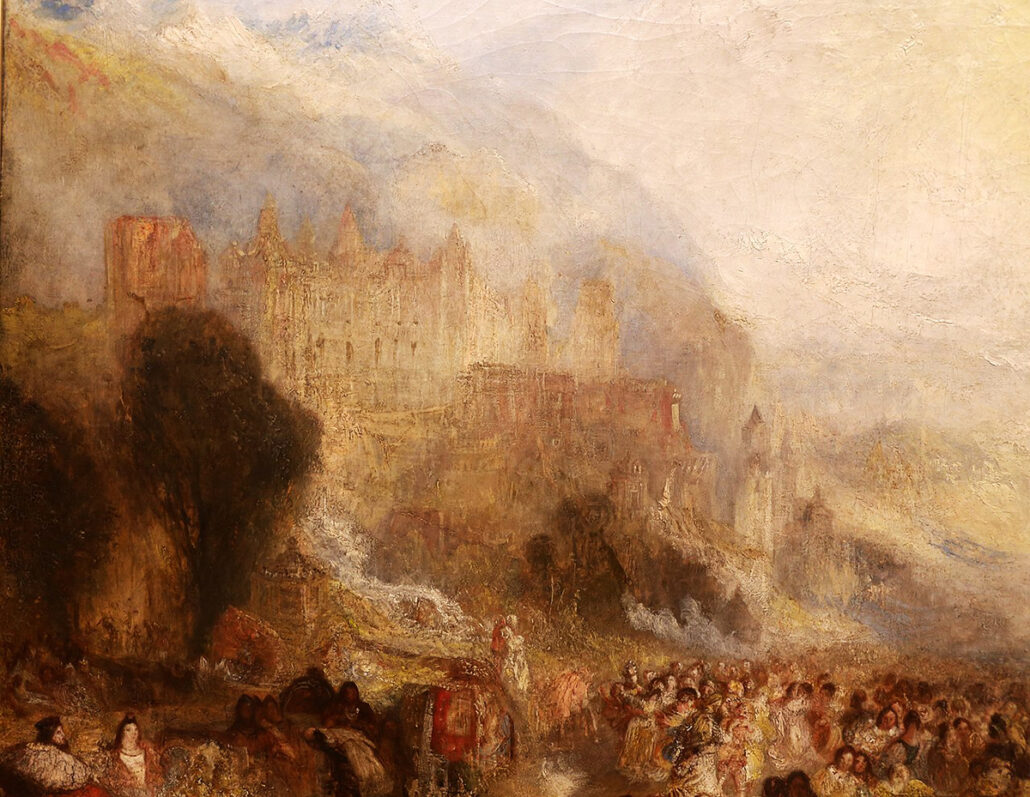
From the Tate Museum
Goethe and Victor Hugo waxed lyrical over the castle’s charms. Mark Twain, who spent the summer of 1878 in Heidelberg, wrote of it:
A ruin must be rightly situated, to be effective. This one could not have been better placed. It stands upon a commanding elevation, it is buried in green woods, there is no level ground about it, but, on the contrary, there are wooded terraces upon terraces, and one looks down through shining leaves into profound chasms and abysses where twilight reigns and the sun cannot intrude. Nature knows how to garnish a ruin to get the best effect.
One of these old towers is split down the middle, and one half has tumbled aside. It tumbled in such a way as to establish itself in a picturesque attitude. Then all it lacked was a fitting drapery, and Nature has furnished that; she has robed the rugged mass in flowers and verdure and made it a charm to the eye…. Misfortune has done for this old tower what it has done for the human character sometimes—improved it.
–A Tramp Abroad
It’s easy to see why they were all so inspired. The castle is a glorious hodge-podge of architectural styles and periods. There are the medieval walls, towers, and casemates of a typical castle fortress, a Renaissance palace, a 17th-century garden, and 19th-century reconstructions.
The primary Heidelberg Castle aesthetic is Renaissance, but for me, the blend is what makes it work so beautifully. It presents the best of all worlds. The “romantic” ruins trigger the imagination. The reconstructed Friedrich’s wing brings the past alive. And the views are to die for.
How to Get to Heidelberg Castle
There are basically two ways to get up to the castle from the town. Well, three, if you have a car, but it is NOT recommended. There is very little parking available, and much of what is there is reserved for local residents. If you do need to be driven, you can take a taxi or Uber up to near the entrance.
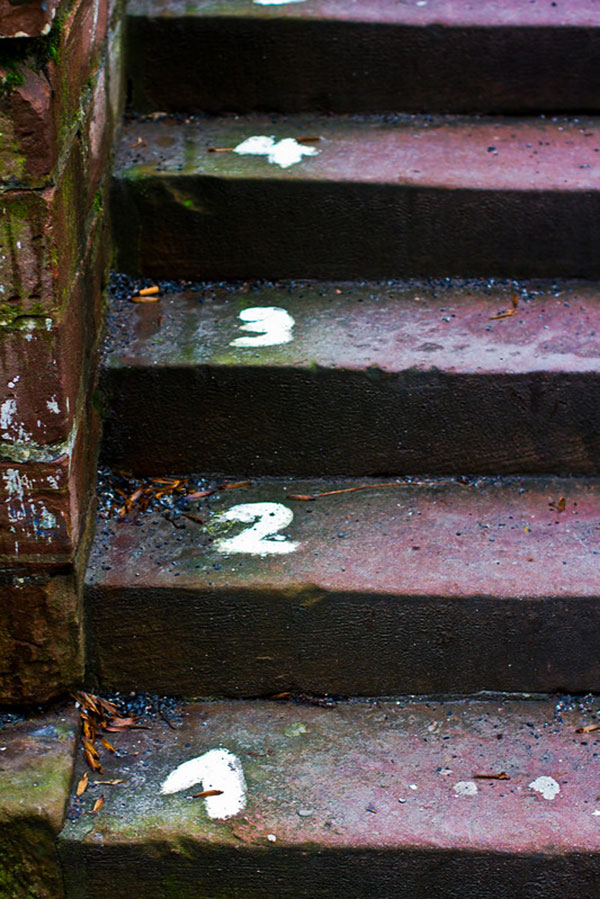
You can climb up to the castle under your own power. It’s a rewarding climb, with some pretty views down onto the river along the way. BUT… it includes some 300+ steps, since you’re climbing halfway up the mountain. And just to help you along the way, the steps are numbered. You’ll know how many are left.
If you don’t wish to walk up, then lucky you! You get to take the Heidelberg Bergbahn, the funicular cable car that goes straight up the side of the mountain. It will whisk you up in just a few moments. And the price of your round-trip ticket includes entrance to the castle grounds (which you will have to pay for anyway if you opt to walk up).
The bergbahn station is situated in the Kornmarkt, an easy walk from anywhere in the Old Town. Or you can take a #33 bus from Bismarckplatz.

Photo ©Hubert Berbench, via Bergbahn Heidelberg
Nerd Alert: Heidelberg Castle History Ahead
My personal history studies covered mostly England, France, and the US, so I was a blank mind on German history when I first arrived in Heidelberg. Let’s take a quick look at what I learned, which made my visit to the castle so much richer.
A Medieval Castle…Complete with Moat
The first mention of a castle in the city shows up around the year 1225, when the Counts Palatine of the Rhine—later the Prince Electors—decided to establish a residence here.
Less than a hundred years later, there was already a moated medieval castle on the hillside overlooking the town. It was a classic defensive castle, and the outer walls and moat (dry now) from that time remain.
Inside the protective walls, the counts built a series of residences and outbuildings. Over the next 300 years, the grounds became a veritable catalog of German architectural styles.
In 1537, a lightning bolt hit the complex and destroyed most of the upper castle. The main style of successive building was Renaissance, including the Ottheinrich Wing and the now-restored Friedrich’s Wing.

Renaissance Beauty & Romance
In 1615, the Prince Elector, Friedrich V, was married to Elizabeth Stuart, the daughter of King James I of England, granddaughter of Mary Queen of Scots, and a cousin to Elizabeth I. Lots of royal blood there!
Like most royal marriages of its time, it began as a political alliance, but it apparently evolved into a love match. Legend says that when Friedrich commissioned the Elizabeth Gate as a birthday gift for his new bride, he commanded that it be completed in 24 hours. And it was.
The expansive castle gardens were also designed at this time, by Inigo Jones and Salomon de Caus, who had come from England as part of the princess’s retinue.

Friedrich also added the English wing at this time beside the main Friederich’s wing as a fitting palace for Elizabeth.
The Thirty Years War (1618-1648) & the Nine Years War (1688-1697)
War has never been kind to Heidelberg Castle, and the Thirty Years War was rough. Religion and trade seem to share claims as the primary impetus for the long conflict. It was Protestants vs. Catholics, and even Lutherans vs. Calvinists, with a constant overlay of eager desire to control the Baltic Sea trade routes.
The French were fighting the Spanish; the Spaniards were going against the Dutch; the Germans were fighting each other. Add in the Danes, Bohemians, and some Scottish mercenaries, and this ugly war pretty much encompassed all of Western and Central Europe.
In 1622, the Imperial Spanish army laid siege to the city and its palace on the hill. The castle held out for 11 weeks before falling, and the castle was ravaged.
The Nine Years War was even worse for this magnificent pile. French forces blew up the Powder Tower. By 1693, the complex was largely destroyed, and the city below it was reduced to a pile of rubble. When that war ended four years later, rebuilding of the city began on the old Gothic layout but in a largely Baroque style. This explains the lovely architectural coherence in the Old Town.
But by that time, the prince electors had lost interest in their badly damaged residence and longed for something more modern. The court was moved to a spanking new and more convenient palace in nearby Mannheim.
Does Lightning Ever Strike Twice?
In 1764, Karl Theodore decided to move the court back to Heidelberg. Repair work was done to the castle. His regal furniture and belongings were shipped to the city and stored in the Church of the Holy Spirit to await his arrival.
They say lightning never strikes twice in the same place. Well, Heidelberg Castle may be the exception that proves that rule. Because in 1764, the very day before Karl Theodor was to move in and make the castle his official seat, it WAS struck by lightning for the second time. And then again, a third time.
It hit the Octagonal Tower, set light to the roof, destroying the double-gabled roof of the English Wing, taking out the entire upper floors of the Ottheinrich Wing, and crashing and burning major sections of the structure. In just a few hours, much of the 500-year-old castle was gone.
The remaining pile of stones, wood, and iron became a quarry for the citizens of Heidelberg to plunder to build their homes below.
Only the Friedrich’s Wing of the castle, though fire damaged, was left basically intact. In the late 19th century, after much discussion and controversy over whether the castle should be “repaired/restored” or “preserved,” that one wing was restored to the palace we see today. The rest of the castle was preserved in its magnificent state of “ruin.”

Planning Your Visit to Heidelberg Castle
On entering the grounds of the castle from the funicular station, you’ll see a new-ish Visitors’ Center ahead on the right. It’s handy and full of useful information. Very much worth a stop.
Try to look past the building itself. For my taste, in the face of the beautiful, romantic, and monumental Heidelberg Palace, this modern building is jarring. Yes, it matches the red sandstone of the castle itself, and the 2-meter-deep window embrasures echo those of the castle, but it is essentially a big, stone block, without ornament or anything else to recommend it. I found it… yes… ugly. There, I said it. Sorry not sorry.
It is, however, extremely practical and well laid out. It houses accessible bathrooms, the ticket office, audio guide rentals (for €6 in 2024), and a very nice gift shop. There is also a lovely view of the castle ruins from the upper terrace.
I suggest you use your time in the visitor’s center to map out your approach. The castle is big and there is a lot to see. This is also where you can book a tour with one of the official castle guides.

I highly recommend you do opt for a guided tour. I was so glad I did. It’s the only way to visit the interior of the Friedrich’s Wing and the Ottheinrich Wing.
Castle guides dress in period costumes and have to go through a three-month training before they can greet visitors, so they really know their stuff. I would have missed so much if I had not done it. They are very reasonably priced at €6 for adults in 2024.
Guided tours are offered in English several times a day, with slightly fewer in the off-season (November 6-March 31) and more frequently the rest of the year. If you’d prefer to combine your castle visit with a private tour of the Old Town and University, this tour might be right for you.
The Graceful Elizabeth Gate
Opposite the visitors’ center, to the left of the main castle entrance, you’ll see the Elizabeth Gate, that overnight monument to Friedrich V’s love for his English princess. Surrounded by trees, the triumphal archway is definitely photo worthy. Look for all the lizards, frogs, and squirrels hiding among the stone carvings.
Beyond the Elizabeth Gate you’ll come to the terrace with my favorite views from the castle. You can not only see the Old Town, with its beautiful buildings and the Heiliggeist Church, the Neckar River, the Philosopher’s Way, and the Heiligenberg beyond. For a look at what you can see and do up there on the Holy Mountain, check out this post. And you can read even more detail about the Thingstätte and medieval monastery ruins located there in this post.


You can also turn around and see the gorgeous mansions climbing up the hillside next to and above the castle. Mark Twain stayed in a hotel that used to be in one of those mansions and loved the view.
From here, you also get the best view of the English Wing. It’s also called the Elizabeth Wing, since Friedrich V built it so his English bride would have a suitable palace of her own. It was the last building to be added to the castle complex, until the Visitors’ Center was built a few years ago. Today, the glassless windows of Elizabeth’s pretty palace open only to the sky beyond.

When you are done with the terrace views, return toward the visitor’s center and veer left.
And Onward to the Castle Itself
With the visitors’ center at your back, you’re ready to enter the main complex. Walk through the first gate and cross the bridge over the dry moat. As you pass through the next pair of arches, look up. You can see the teeth-like points of the medieval portcullis, the barrier that would slide down to stave off intruders. A few more steps and you are in the cobblestoned courtyard of the main castle.
If you’re like me, you will have to stop dead in your tracks and take a deep breath. Because this place is breathtaking. It’s big! And impressive! And very, very beautiful.
On your immediate left and right as you enter are the oldest buildings of the compound, as well as the medieval well that supplied the castle with clean water. But what will really grab your eyes and hold on is the building dead ahead, the Friedrich’s Wing, built by Friedrich IV, Duke of Bavaria. It is glorious.
The Friedrichsbau
This classic example of German Renaissance architecture was built from 1601-1607. Friederich used the façade as a veritable ancestral family tree in stone, embellishing it with 16 statues of the kings and emperors of the House of Wittelsbach, reaching all the way back to Charlemagne. Friedrich himself anchors this genealogy in the last statue on the right of the bottom row.
This is the only part of the palace living areas that were restored after the fire damage of 1764. If you opt for one of the official tours, you can go inside this building. I strongly suggest you do.
You’ll have a chance to see the palace chapel. It’s very popular today for weddings. Perhaps you’ll see one while you’re there. Upstairs are the refurbished royal rooms, and they are lovely. The fanciful stucco ceilings were recreated in the late 19th century in Renaissance style.


Photo © Schloss Heidelberg.
The Ottheinrich’s Wing
On your right as you face the Friedrichsbau is the Ottheinrich’s Wing, or what’s left of it. This is generally considered the finest example of a German Renaissance façade in existence. Notice the fine statues of Biblical and mythical figures, including Joshua, Hercules, and Samson.
Like those from the Friedrichsbau, the originals have been moved inside for preservation and replaced here with replicas. A guided tour will give you an up close and personal look at the authentic ones. You will also get to see the Imperial Hall, a gorgeous space. Much of the detailing in this room is original to the mid-16th century.
The original double-gabled roof of this building was smashed by Louis XIV’s cannons and finally destroyed completely in the 1764 lightning strikes and following fire. Only the ground floor was left with its roof intact. The empty windows above now look out blankly against the sky. It makes for an impressive scene.

In the lower level is the arched entrance to the German Apothecary Museum. Entrance is included in your general castle ticket. Do give yourself the gift of visiting. I found it so fascinating and so much more expansive than I expected that I will have to write a whole separate post about it.
The Heidelberg Tun—the World’s Largest Wine Barrel
Next, we head to the Barrel Room. Facing the Friedrich’s Wing, turn to your left and head down the long, sloped ramp. At the bottom, you’ll walk through an arched opening, draped with curtains embellished with the city’s coat of arms.
Once inside, you will see a huge wooden wine barrel on your right with a normal-sized barrel sitting next to it. You’ll think you’re there. You’ll think, Wow! Pretty big, right?
But wait. Keep going, around to the left of that barrel, then veer to your right. You’ll see a pair of gate-like doors opening onto a stairway. Go through there.
And there it is, the Great Heidelberger Tun, the World’s Largest Wine Barrel.
Unfortunately, the space in front of the barrel is small, making it hard to get a good photo, especially at crowded times.
Your best bet is to stand at the top of the stairs as you enter and wait for the people to clear, if possible. You can get a good shot then.

The barrel originally had an ingenious system of pipes and pumps attached to carry wine directly from here to the king’s royal party-goers. Yes, even in the 18th century. That surprised me.
The barrel has been a tourist attraction for a good long time. Fistfuls of famous writers have mentioned it, ranging from Victor Hugo, Herman Melville, and Jules Verne, to Washington Irving, Heinrich Heine, and Ezra Pound. And of course, Mark Twain.

Continue up the stairway on the right to the top of the giant barrel. It’s so large there’s a dance floor up there. And it has actually been used for that.
On the way up, there’s a couple of small windows in the outer wall that give you a good sense of the thickness of the castle walls at this point. You can walk out onto the dance floor and look down, walk around the barrel, and then come back down the spiral staircase on the other side.
Back on the ground floor, you can see the statue of Perkeo facing the barrel. This cute little guy has an amusing story of his own to tell.
The Story of Perkeo, a Court Favorite
Perkeo, a dwarf, was the court jester and cup-bearer to the Elector Palatinate Charles III Phillip. He also became the official guardian of the castle’s wine supply and therefore of the barrel. It was the perfect occupation for this guy because he was famous for his ability to drink massive amounts of wine.
Whenever anyone at court asked him if he wanted another glass of wine, he would answer “Perché no?”…(“Why not? In Italian). Thus the nickname, Perkeo, stuck. They say he regularly drank from five to eight gallons of wine a day, despite his diminutive size, and never ever touched water.
However, when he fell ill one day, the doctor recommended he stick to water. He gave in, drank one glass, and promptly died the next day.

Perkeo is the unofficial mascot of the city of Heidelberg, and you will see both his name and depictions of him, with wine glass in hand, throughout the city. You can even take him home in the form of a charm, a postcard, a beer stein, or any number of other Heidelberg souvenirs.
Time for a Beer or Snack?
Touring world-class monuments is such thirsty work. My suggestion now is to head back to the Visitors’ Center for a stop at the Sattlekammer Cafe-Bistro in the old Tack Room. If the weather is nice, grab an umbrellaed table on the terrace, where you’ll have a great view of the castle while you nibble on some delicious currywurst.
What? You haven’t tried German currywurst yet? Oh my, you have a delight in store. Chunks of good German sausage in a curry-ketchup sauce. It’s unique and I surprised myself by how much I liked it. Pair it with a glass of their in-house Schloss-Kellerbier for a perfectly German experience. Or just grab a cup of good Lavazza coffee and a pastry or pretzel, something to tide you over until you can hit one of the great Heidelberg restaurants down the hill.
The Rest of the Story
That concludes our tour of Heidelberg Castle inside the walls. But there are still discoveries to be made. You definitely need to set time aside to visit the Hortus Palatinus—the Royal Gardens of the castle. But they are so extensive and their story so fascinating, that the subject is worth a separate post of its own.
I hope I have convinced you that a visit to Schloss Heidelberg will reward you in many ways. I feel so much richer for the experience.
Heidelberg Castle FAQs
Is Heidelberg Castle worth visiting?
Very much so. At least I think it is. And I hope this article has convinced you as well. The castle is romantic in nature, beautiful to view, and deeply rich in history. You’ll come away smarter and happier. Besides that, the views alone are worth the trip up.
Can you drive up to Heidelberg Castle?
It’s possible to drive to the castle, but the parking is very limited and mostly reserved for local residents. If you need to ride up, I suggest taking a taxi or Uber and arranging to be picked up again when you are done.
How many steps are there to climb up to the castle?
Three hundred fifteen—count ‘em—315 steps will get you up to the castle. And they are numbered, just to be sure. There is an alternate path you can walk up—or down—that leads to the gardens. It is steep and long, and will give you a work-out, but it does offer wonderful views.
Was Heidelberg Castle destroyed by bombing in World War II?
No. That’s what I assumed before my first visit there, but the castle was already a ruin long before the 20th century. Heidelberg was spared the bombings that destroyed so many other German cities during World War II. For that reason, the Baroque buildings of the Old Town and the ruined castle overseeing it create a cohesive romantic ambiance.
How long does it take to tour Heidelberg Castle?
The official guided tour of the castle takes one hour, but there is much you will likely want to see beyond the tour. This includes the German Pharmacy Museum, the Hortus Palatinus Gardens, and the views from all the terraces. I suggest you allow three hours to see everything without feeling rushed.
Can you go inside Heidelberg Palace?
Except for the pharmacy museum and the giant barrel room, the inside of the palace can only be visited on an official guided tour. They are run frequently, are reasonably priced, and can be booked in the Visitors’ Center.
Is it worth going inside Heidelberg Castle?
Yes, I think it is very worth visiting the interiors of the castle. The chapel and the rooms of the royal residence are lovely and historically interesting. And the guides are exceptionally well informed about the history and the details. They really bring it alive for you.
Is Heidelberg Castle accessible to all?
In eons past, people didn’t think much about building accessibility into their fortresses and castles. Unfortunately, that means that parts of Heidelberg Castle are difficult to negotiate for people with limited mobility. The courtyard is paved with uneven cobblestones. There are stairs in a couple of places, though there are steeply ramped options in most of them (not all). Crutches, canes, and other walking sticks must have rubber tips. The terraces and gardens are relatively easy to neogiate for all.
The funicular is wheelchair accessible as far as the castle stop. Above that, not so much. There are lifts with open hydraulic ramps at the Kornmarkt and Molkenkur (Castle) stations. There are also wheelchairs available for loan to passengers with restricted mobility on this lower section to the castle. Just ask the staff at the station in Kornmarkt.
The entrance to the barrel room is down a ramp, not too steep. Then there are stairs to get down to the barrel itself, but you can see it clearly from the top of the stairway. The Visitor’s Center is completely accessible, including accessible toilets.
What are the opening times for the castle?
The palace courtyard and the giant barrel are open daily from 8:00am to 6:00pm (last entry 5:30pm
The German Pharmacy Museum (Deutsches Apothekenmuseum) is open April to October from 10:00am to 6:00pm (last entry 5:40pm), November to March from 10:00am to 5:30pm (last entry 5:10pm)
The gardens are open to the public during daylight hours.
What is the admission price to Heidelberg Castle?
The general admission price to the castle grounds, gardens, Apothecary Museum and Barrel Room in 2024 is €9.00 for adults. This includes the round-trip fare on the funicular. Guided tours are an additional €6.00.
Depending on how long you plan to stay in Heidelberg and what you plan to do there, it can be a much better deal to get the Heidelberg Card. The card includes entrance to the castle and the round trip on the bergbahn funicular to get there. It also includes the use of all public transport for the duration of the card. I used to get around town every day. I also used my card for a city walking tour, free entrance to the University Library, free entrance to the Studentenkarzer/Student Jail, (my favorite!) plus many other discounts on entrance fees, restaurants, and shops. There’s also a Heidelberg guide and a handy city map that comes with it. You can buy the City Card for 1, 2, or 4 days, and the price is very reasonable.
Pin it for Later


Thank you Donna for a great interesting review of the castle. I now know where my next trip will be in the fall. When do you think would be the best time to visit in SeptemberOctober?
Thanks for your comment, Connie. I think September would be the perfect time to visit Heidelberg. I was there once at that time and the weather was ideal–mid-hi 60s most days, as I recall. Nice for hiking or strolling through town and enough sun to enjoy an outside terrace if you want. Also, the whole month of September features “Heidelberg Herbst” (Heidelberg Autumn). There are festival events, vendors stands, a flea market, live music every weekend. There’s more info about it at Heidelberg Marketing.
Also, be sure to read my other posts about Heidelberg. I’m writing a few more but there are already 6 or 7. Here’s one I just published about the German Apothecary Museum. And the ones about the Student Prison and Riding the Funicular are fun, I think.
Have a wonderful trip!