
Visiting the Thingstätte, Heidelberg: an Older Woman’s Quest for Understanding
But there are shadows on this sunny charm, as there are in cities all over Germany. The Thingstätte, in Heidelberg, is one of those shadows, a silent witness to a once ugly part of its history, now mellowed with age. I was moved to visit this huge stone amphitheater on a sunny day in September, hoping it would not ruin my deep admiration for this city of my ancestors.
This post may contain affiliate links. If you click on one of these links and make a purchase, I may receive a commission, for which I thank you. For more information, visit our privacy and disclosure page.

Hiking to a German “Thing”
Sited atop Heiligenberg (Holy Mountain) across the Neckar River from the Altstadt, a monumental amphitheater was built in the 1930s to help meld and maintain a culture, a nationalist society, a cult of faith in the National Socialist movement. The Nazis.
Because Hitler did not merely want to conquer Europe. He wanted to completely redesign German cultural life. And a new Nazi architecture was one of the ways he meant to do it.
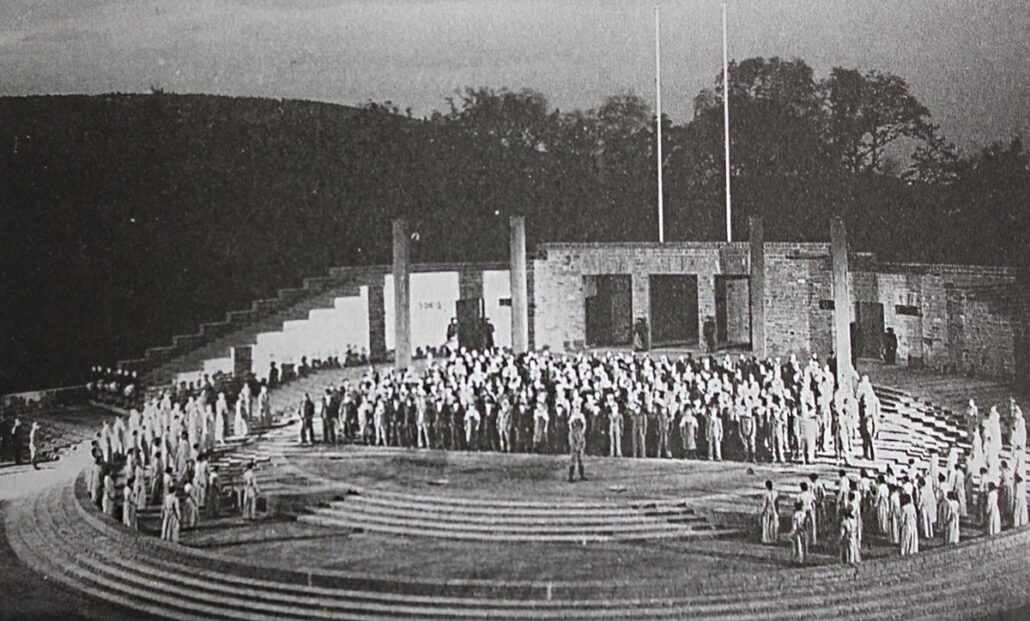
Such places, and the rallies, torchlight processions, flag displays, choirs, and other nationalistic entertainment that took place there, had a specific purpose. A local newspaper described it well: “The Thing as a place of worship for the National Socialist faith.”
As a Baby Boomer myself, a child to whom World War II was very recent history that had strongly affected my parents’ lives, I’ve always been both horrified and intrigued by that history. It has made me want to look deeply into that abyss and ask: Why? How?
Like many of our generation, I read The Diary of Anne Frank when I was just about Anne’s own age and cried when I stood in her room in the hidden attic in Amsterdam. That deep interest has caused me to visit the Terezín ghetto and concentration camp in the Czech Republic, spend time at the Resistance Museum in Amsterdam, and learn about the stolpersteine, the largest monument to those lost in the Nazi Holocaust spread all over Europe.
So when I learned about the Thingstätte in Heidelberg, I was intrigued.
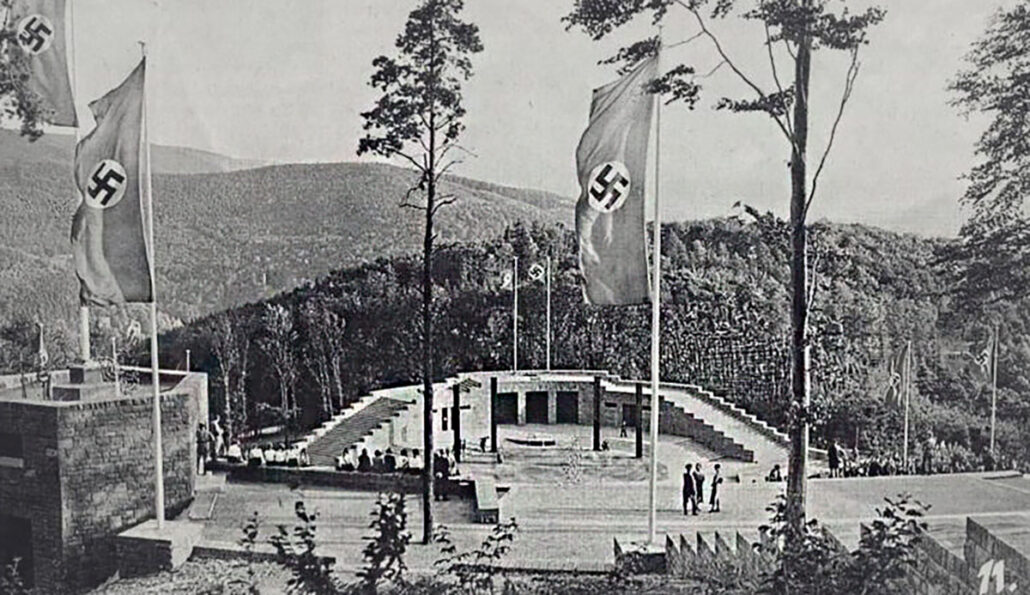
“In my snooping around town for ghosts, I had discovered the solidest ghost of all – a Nazi amphitheater nestled in the hills above Heidelberg. Going there became an obsession with me. Nobody in Heidelberg seemed to recognize the existence of the place and this denial gave the amphitheater an added appeal.”
I had to see it. And I’m glad I did, because even apart from its dark past, this imposing structure has its own intriguing pull at visitors. Its spectacular views down onto Heidelberg, the Old Town, the ruined castle, and the Neckar River make it a site you really shouldn’t miss on any visit to Heidelberg.

Let’s uncover why a visit to Thingstätte should be on your Heidelberg itinerary.
What is a Thingstatte and Why Was it Built?
The name of this odd space can be translated into English as “Thing Place.” A Thing was a kind of gathering/performance with music and stories and chanting that came from old Norse times.
With strong echoes of the ancient Greek theaters, a culture the Nazis looked up to with respect, pinned to a desire to mimic those ancient Nordic pagan gatherings, the design differed according to terrain but very little in basic effect.
In the end, only about 50 of the originally planned 400 were actually completed before Hitler and Goebbels, his propaganda minister, decided a better way to reach and inspire the people in this new cult of faith was through radio and film.
Why Heidelberg?
The Heidelberg arena was one of the first to be constructed, perhaps because Speer was born in Heidelberg and spent much of his childhood in the city. And Goebbels earned his PhD at the famous Heidelberg University and remembered it fondly. He called this lovely spot on the Neckar a “living breath of the German soul” and a “focal point of imperial thought.”

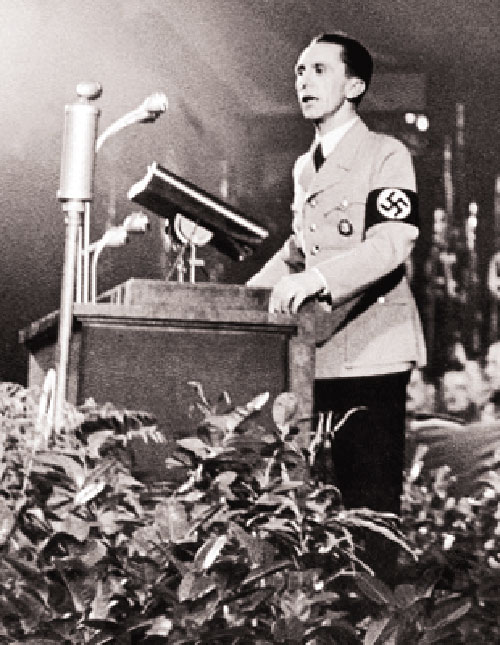
So they decided Heidelberg as a city should help National Socialism gain admiration and recognition worldwide as the new “Salzburg of the German southwest.”
Construction began in 1934. At the ceremony to lay the foundation stone, the city’s mayor announced his hopes that the “red, blood-colored sandstone [might] become a popular site for new seeing and hearing.”
It opened the following year, on the June solstice and with Goebbels himself addressing the crowd. He exalted the complex as the “true church of the Reich” and described it as “National Socialism in stone.” Here’s part of what he said that night:“
In this monumental building, we have given our style and our view of life a lively, sculptural, and monumental expression. […] These sites are in reality the state parliaments of our time. […] The day will come when the German people will walk to these stone sites in order to confess their imperishable new life in cultic games.”
The Thingstätte Today
One thing about the Nazis. Their architecture was made to last. And the Thingstätte has done exactly that, though somewhat mossy in places.
When you come up the hill to the entrance, step through the gates and past the huge square stone pillars, you’re standing at the back of the stage, gazing out into the wide-open space. The monumentality of the thing hits you. It’s big.
The 56 rows of stepped stone rising 25 yards/meters in height, provided seating for 8,000 people with room for about 5,000 more standing. The opening, however, hosted over 20,000 eager participants.
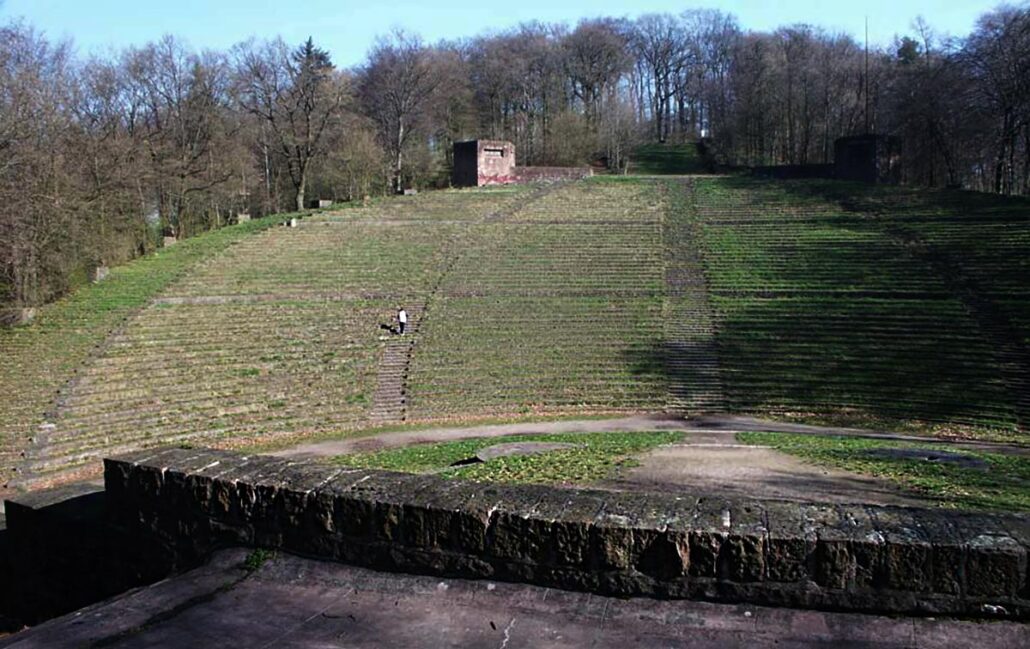
The large, round stage area is backed by a stepped wall and a building for dressing rooms and technicians. Two small semi-circular jutting stages mark the front edge. An almost seamless flow into the forecourt and audience area invited participation from the public. A pair of towers provided space for flags, lighting, and sound equipment.
The Thingstätte’s echoes tell you this was intended to be a sacred place. Its object? Celebrating the Nazi hero cult. It’s not hard to imagine a forest of red and black Nazi flags flapping, torches blazing, and people chanting.
On the other hand, I chose to picture instead a different, more benign usage of this amazing space. Its open layout seems perfectly designed for a Shakespeare play. I can easily imagine Iago strutting across the stone stage or Hamlet sitting on a forward step contemplating poor Yorick’s skull.
Or better yet, a Brunhilde, her spear flashing in the spotlights as she ho-yo-to-hoes across the space, Wagner’s magnificent crescendos swirling about her.
After the War, with the Nazis Gone
The original space had some quite sophisticated equipment for its time, including a sound mixer with loudspeakers and spotlight lighting. But the natural acoustics of the amphitheater are actually amazing. Standing at the top of the stepped seating area, you can hear someone speaking in a normal voice down on the stage, nearly 200 yards/meters away.That has made it an excellent venue for musical performances. There have been jazz concerts, rock, and opera nights. Placido Domingo and Montserrat Caballé, among others, have performed here.
From the 1980s until 2017, an ad-hoc celebration of Walpurgisnacht was held every year on May 1st. Thousands of people from all over the country descended on Heidelberg for that one night of celebration, even though there was no electricity at the site. Unfortunately, this fact led to frequent forest fires from all the candles and bonfires that lit the place up like a witches’ gathering. In December, 2017, the city banned future Walpurgisnacht celebrations.

Today, local officials seem ambiguous about promoting the Thingstätte. It’s preserved as a monument, but access is not easy for large crowds, and the area for parking is limited. I sense it is rarely used today, but it is definitely worth asking at the tourism office if any events are planned while you are in town.
Why Visit the Thingstätte Nazi Amphitheater?
There are several reasons to visit the Heidelberg Thing today, beyond its fascinating history and specific beauty. For one thing, the feeling of a sacred history is intense. The name Holy Mountain is no accident. This was a Celtic site in millennia past. Early Germanic tribes prayed here. So did the Romans. The Germans built the amphitheater right on top of some ancient Celtic ruins.
The day I was there, I saw several people enjoying a day out, eating picnics on the stepped seating, kids running across the stage, a couple of boys kicking a soccer ball. A younger generation has fewer dark images of why this massive amphitheater was built.
And that’s a good thing, I think. Let the past settle, never forgotten but left behind. Enjoy the sunshine, the fresh breeze through the trees, the clear air.
For this spot is more than just a relic of the past, if we let it be. It can be a living testament to both our understanding of past horrors and a confirmation of our aspirations for the future, where we make firm our commitment to a world built on tolerance, compassion, diversity, and justice.
The Thingstätte on Heidelberg’s Heiligenberg/Holy Mountain is free and open, with no fencing or other barriers, so no need to worry about closing hours. You might decide to stay to watch the sunset behind that amazing view.
What Else Can You See up on the Heiligenberg?
This Holy Mountain has a super-long history spanning from Celtic times through Roman, medieval, and modern. Bits and pieces of that history have been dug up, preserved, restored, and made accessible by the Celtic Trail.
This easy circular hiking path passes the Thingstätte and leads to the highest point on the mountain, where you can see the medieval ruins of the Michaelskloster.
Visiting the Medieval Michaelskloster Ruins
A mere 200 yards/meters’ hike beyond the amphitheater brings you to the ruins of the Michaelskloster, an 11th-century monastery that feels like a sanctum of peace after the roiling emotions of the Thingstätte. The history of the site goes back some 7000 years, including a Celtic fort with a moat and Roman shrines to Jupiter and Mercury.
The Benedictine monastery was built atop the earlier ruins, so the site has an aura of deep roots, thick with religious and mystical significance.

Evidence of the north-facing Roman temple has been found directly beneath the medieval basilica. Apparently, some of those Roman stones were used in the later construction. The outline of the original Roman temple is marked with stones in the apse of the ruined Basilica of St. Michael.
Allow yourself to feel the age, the spirituality, the peace. Imagine the monks walking around, robes swishing in the silence. This was a holy place, but also a place of people and their work and their lives.
By 1537, the monastery already lay in ruins. The story is that the last three monks to live here were all killed when a tower collapsed onto them.

Two climbable towers, built in the 19th-century from the monastery stones, are intact, along with the early foundations and some walls. Things are well marked, but unfortunately only in German, and I had no cell service to help with translations. Still, the graphics do a decent job of explaining what you are seeing. If you want to climb the tallest tower, as I did, the steps are solid with a good handrail and well lit. It’s about 10 meters/33 feet tall. When you emerge at the top, the views are breathtaking.
Unfortunately, the Michaelskloster ruins are not accessible for those in wheelchairs or with severe walking difficulties. The path past the Thingstätte is short but it’s steep and a bit rocky and also features steps.
The ruins are free to enter and explore. There is a fence and a gate. Opening hours seem to vary a bit but are generally 10am-4pm.
Visiting the Stephanskloster Ruins and the Heidenloch
From the Michaelskloster, make your way back down past the Thingstätte to the Waldschenke Biergarten, and continue toward the river another few yards/meters to the parking area. You’ll come to another set of medieval ruins, the Stephanskloster.
This monastery was first begun in 1090 by a Benedictine monk named Arnold from the Michaelskloster. He wanted a hermitage and private chapel apart from the mother house.
But a mere four years later, poor Arnold’s solitude was interrupted when the provost of the main monastery took a liking to the spot. The hilltop was bare at that time, making the views of the entire valley wide open from this particular outlook. The provost added a few more buildings…and a few more monks. The new monastery was dedicated to St. Stephen.
The primary donor for the new monastery was a Crusader. His widow, named Hazecha, was buried in the western part of the church, and you can still see her gravestone there.
The ruins are lovely and peaceful in the dappled light filtering through the trees. The day I was there, it was nearly deserted and I could really feel the peace of the place seep into my soul.

The End of the Monasteries
In 1555, German society and history was rocked by the Reformation. Catholic monasteries were no longer desired or allowed. The Count Palatinate took possession of both of the Heidelberg ruins. A few years later, St. Stephen’s was gifted to Heidelberg University, which decided to raze it and sell the stones. Since it served as a quarry for the city, it’s intriguing to look for stones throughout Heidelberg that might have come from here.
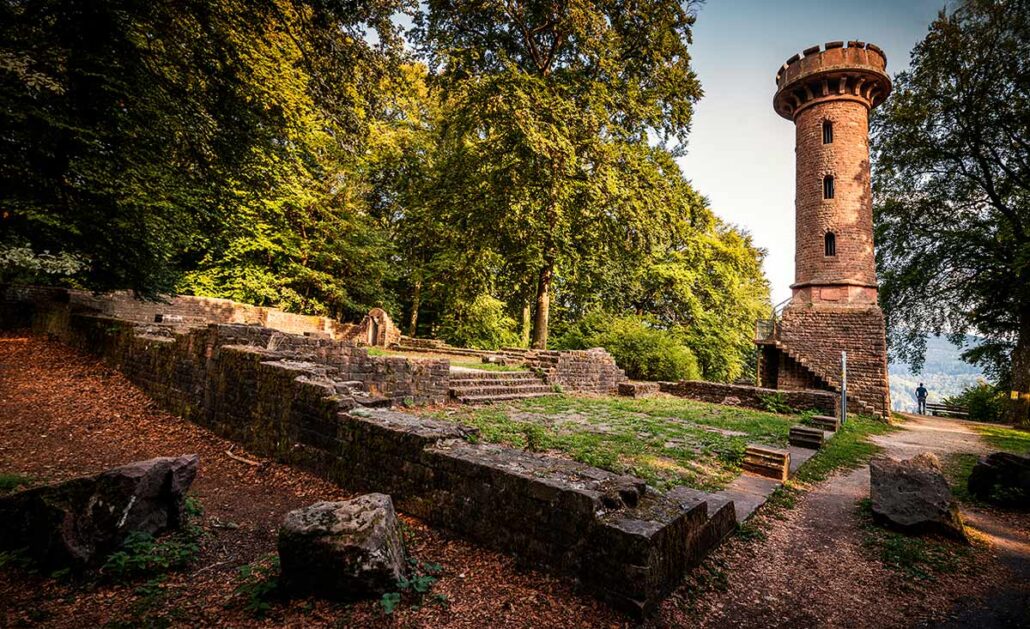
In the 19th century, a lookout tower, the Heiligenbergturm was built from stones from the monastery. It’s about a 75-step climb to get to the top, but you are rewarded with a glorious view of Heidelberg Castle, the Köningstuhl, the town, and the river.
The climb is free but make a note. The tower is closed on Mondays.
For those who don’t wish to climb it, there are benches at the base of the tower where you can sit and enjoy the view. The tower now belongs to the city of Heidelberg.
The Heidenloch or Heathens’ Hole—What Was it For?
At the edge of the Stephanskloster ruins is a deep hole called the Heidenloch. The 56-meter-deep shaft hewn into the rock is swathed in mystery. The diameter is 3-4 yards/meters.
No one is certain exactly who created it. Or why. The most likely explanation is the search for a water source by the Romans or even earlier people. That search was ultimately unsuccessful.

The shaft was walled over for many years. It was finally opened in 1936 by the Kurpfälzisches Museum. The bottom of the shaft was found to be lined with bricks. Many medieval objects from the monastery, such as metal utensils, keys, stirrups, and knives, were found during the excavation.
A modern shelter was built over the shaft to protect it from the elements—and from visitors—as well as protect those visitors from this very deep hole.
End Your Day on Heiligenberg with a Hearty Prost
After all this exploring, you might feel the need of sustenance. I certainly did. And fortunately… here it is. The Waldschenke Beer Garden and Restaurant has been right here on the side of the Holy Mountain since 1929. The current owners have had it since 2011.
It’s the perfect way to end a German day with a truly German meal…and German beer if you like it. The menu is filled with typical German dishes, like schnitzel, spaetzle, and yummy apple strudel. Their specialties are wild game—particularly wild boar and venison—and fresh-caught trout on weekends.
The place was crowded when I arrived hot and thirsty from my hours of walking. But they found a spot for me at a table under the linden trees and punctuated by a bright blue umbrella.

At my waitress’s suggestion, I ordered the wild boar sausage, something I’d never eaten before. And why not? How scary could it be, right? I’m glad I did. It was delicious, along with its mashed potatoes and red cabbage. The beer was ice cold, a perfect complement to the meal. And then there was that apple strudel, flaky and fruity and not too sweet, served with warm vanilla sauce.
Note: During the winter months (January-February, the Waldschenke is only open Friday through Sunday. The rest of the year, it is open Wednesday through Sunday from 11:00 am.
A Heidelberg High Point
My day spent on the Heiligenberg, a day marked by the contrast of a Nazi amphitheater and medieval monastery ruins—and filling my stomach with yummy German specialties—was a highlight of my visit to this beautiful, charming, and oh, so, romantic city on the Neckar where my grandfather was born.
I hope you enjoy your visit as much as I did. If you’ve been there already, please let us know in the comments what you thought—and if I missed anything.
How to Get There
For detailed directions on how to get to the Thingstätte, the ruins, and other sites on the Heiligenberg discussed here, check out this full informational post on the Heiligenberg, in Heidelberg, Germany.
Pin it for Later:


</)
I really enjoyed this article! My husband grew up in Heidelberg, and we’ve visited several times. He has a story about Led Zeppelin performing an impromptu concert at Thingstatte, and I have a picture of him sitting at the top, near where he sat at that concert. He also tells me that the tower at the St. Stephen’s ruins was known to him and his friends as “the witch’s tower”. I wish I could post the pictures with the comment.
Thanks Tamara, I’m glad you enjoyed the post. What fun for your hub to have the memory of that Led Zeppelin concert there. And what a great spot for it. The photo you took of him there was a great idea. I have a lot more Heidelberg posts coming up in the next couple of weeks. I hope you will enjoy them also.
Donna,
What an great insight into Heidelberg. Our 2 couples have just about retired and now travel 2-3 times a year from Dallas. Flying into EU we have things working well (post Covid) to transit thru FRA then using Lufthansa to connect further in to Europe. Coming back we spend the night at the Frankfurt Airport hotels, and fly out the next morning. Since FRA sits on the main train line, we are able to go to Heidelberg or Koln for the afternoon or dinner, without issue.
AltStadt Heidelberg is our favorite and surprisingly our wives like the dark beer at Vetter Brauhaus. We have seen the University, the student Karcher, and I have been looking at the Philosophers walk and the Heilegenberg and the Thingstadt, definitely moves a visit up on our list. Was also looking at the Heidelberg Catechism and any history still in evidence, but it looks like anything pre-Nine Years War was razed.
I’m glad you found the Heidelberg section useful, Matthew. It is such a lovely and speaks to me especially since my grandfather was born there. Tell your wives I will try the dark beer at Vetter Brauhaus on my next visit and thank them for the tip!
When I was in the US Army myself and friends would camp out at Thingstatte. What a great time we had. Cerca 1971 and 1972. At night you could look down at Mannheim and see the street lights come on starting at the center of town and go to the outskirts.
Thanks for that memory, Dale. It’s nice to think of it in more pleasant terms than its original use.